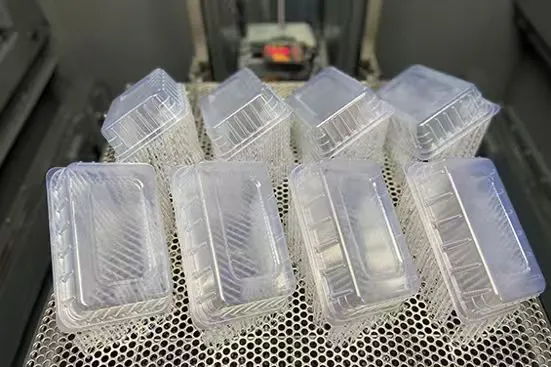
The way products are made is changing. Gone are the days when 3D printing was only for small prototypes. Today, manufacturers use production-grade systems to produce end-use parts, tools, and complete production runs.
At the center of this shift is the industrial SLA printer. It combines the precision of traditional SLA technology with the scale needed for real manufacturing.
This guide is for production managers, engineers, and business owners. You will learn how large format 3D printing enables faster, more flexible workflows. You will also discover which 3D printing materials work best for different industrial applications.
Let’s dive in.
What Is an Industrial SLA Printer?
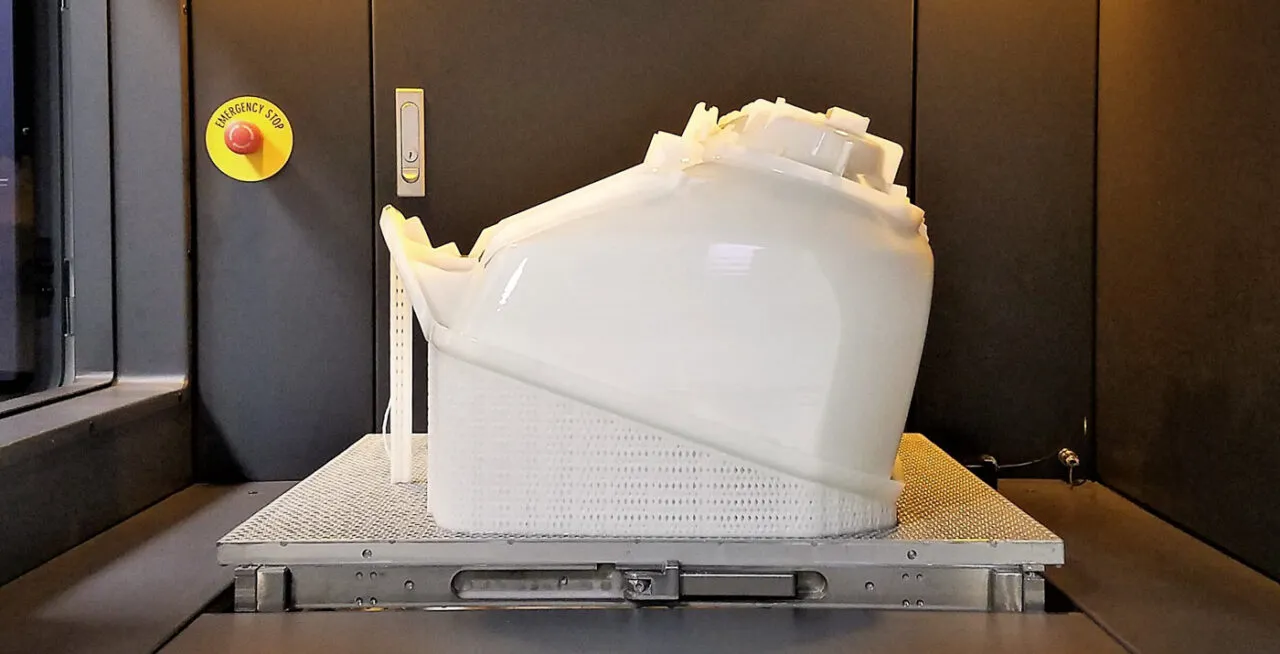
An industrial SLA printer is not simply a larger desktop machine. It is a production-grade system built for continuous operation, engineering-grade resins, and repeatable accuracy across thousands of parts.
SLA Printer Basics
SLA (Stereolithography) is the original 3D printing technology. It uses a laser to cure liquid photopolymer into solid plastic, layer by layer.
A standard desktop SLA printer works well for small, detailed parts. But an industrial SLA printer takes the same core technology and scales it for manufacturing environments.
What Makes It “Industrial”?
| Feature | Desktop SLA | Industrial SLA |
| Build volume | < 200 x 200 x 250 mm | 500 x 500 x 500 mm and larger |
| Uptime | 8–12 hours/day | 24/7 continuous |
| Automation | Manual | Resin dispensing, part removal |
| Materials | Standard resins | Engineering, flexible, high-temp, certified |
| Service | User only | On-site support contracts |
If you cannot run it for three shifts without intervention, it is not an industrial 3D printer.
Why Large Format 3D Printing Matters for Manufacturing
One of the biggest limits of desktop 3D printing is size. You cannot print a full car dashboard, a large assembly jig, or an industrial mold on a small machine.
That is where large format 3D printing changes the game.
What Is Considered Large Format?
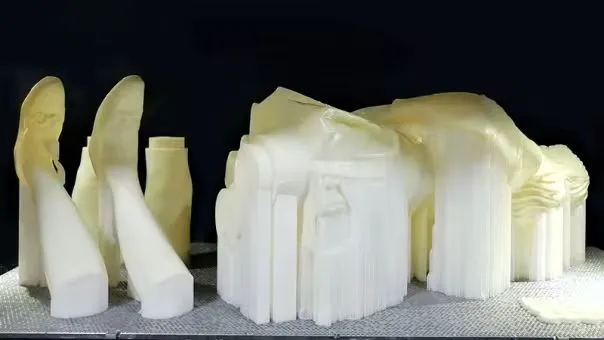
There is no official standard, but in resin 3D printing:
| Category | Build Volume (approx.) | Use Case |
| Desktop | < 5 liters | Prototypes, miniatures |
| Professional | 5–15 liters | Functional parts, dental |
| Large format | 15–100 liters | Industrial tooling, automotive parts |
| Very large format | 100+ liters | Aerospace, marine, furniture |
A large format 3D printer allows you to:
- Print parts in one piece instead of gluing multiple smaller pieces
- Produce full-scale tools and fixtures for factory floors
- Manufacture end-use parts for automotive, aerospace, and medical industries
Large Format SLA vs Large Format FDM
| Aspect | Large Format SLA | Large Format FDM |
| Surface finish | Smooth (no layer lines) | Rough (visible layers) |
| Accuracy | ±0.1–0.3 mm | ±0.5–1.0 mm |
| 3D printing material options | Resins (flexible, tough, high-temp) | Thermoplastics (ABS, nylon, PC) |
| Speed | Faster for complex geometries | Slower |
| Post-processing | Washing + curing | Support removal + sanding |
For applications requiring smooth surfaces, tight tolerances, or flexible resin material properties, large format SLA is superior to FDM.
Industrial 3D Printer Applications in Rapid Manufacturing
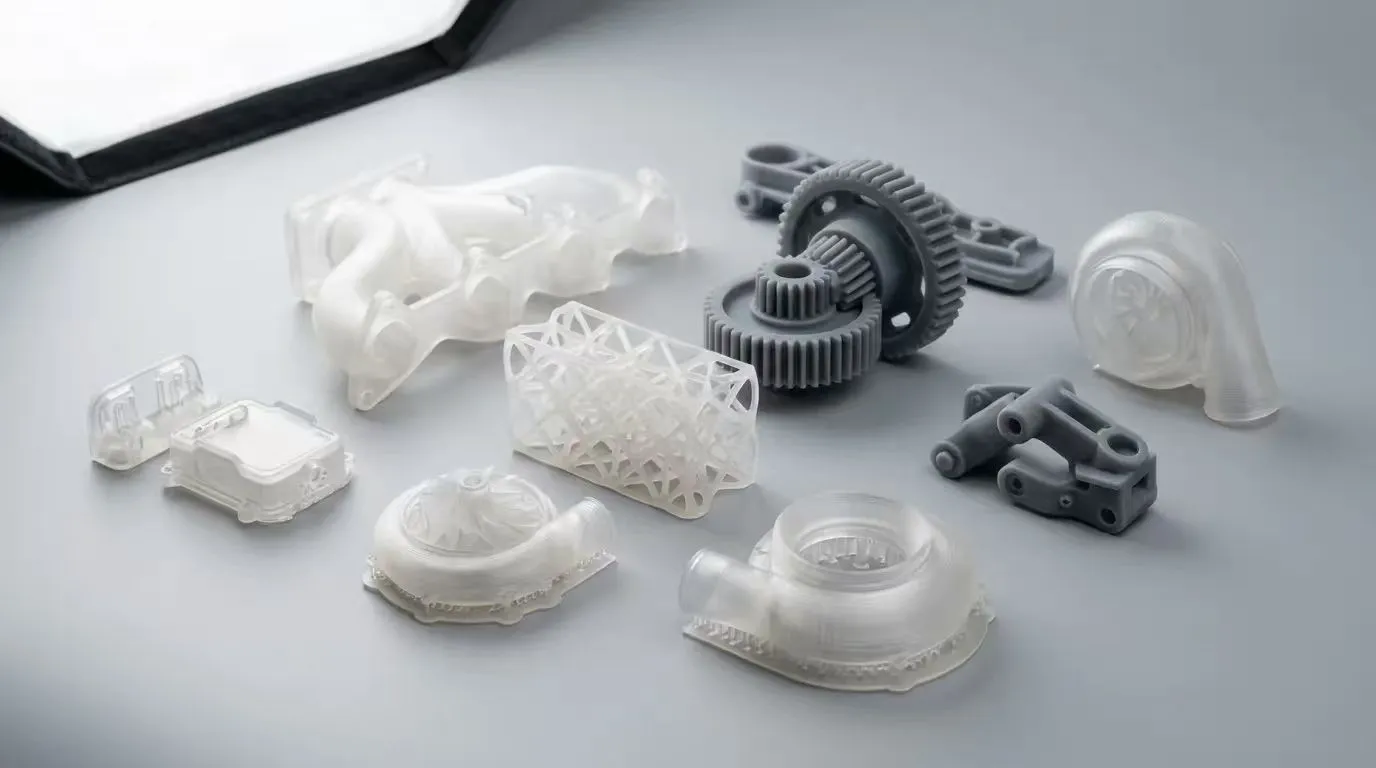
Rapid manufacturing 3D printing is different from rapid prototyping.
- Rapid prototyping → quick models to test form and fit
- Rapid manufacturing 3D printing → production of end-use parts, often at speed
Real-World Applications
| Industry | Application | Why industrial 3D printer? |
| Automotive | Custom jigs, fixtures, soft jaws | Needs large format 3D printer for full-scale tools |
| Aerospace | Ducting, brackets, tooling | Requires certified 3D printing materials |
| Medical | Surgical guides, anatomical models | Needs biocompatible resins |
| Manufacturing | Production aids, assembly line tools | Demands rapid manufacturing 3D printing speed |
| Consumer goods | Ergonomic grips, custom-fit products | Uses flexible resin material |
Rapid Manufacturing vs Traditional Manufacturing
| Aspect | Traditional (Injection Molding) | Rapid Manufacturing 3D Printing |
| Tooling cost | $10,000–$100,000+ | $0 |
| Lead time (first part) | 4–12 weeks | Hours to days |
| Per-part cost (low volume) | Very high | Low |
| Design changes | Expensive and slow | Free and fast |
| Complexity limit | High (draft angles, parting lines) | None |
For low-to-medium volume production (1–10,000 parts), rapid manufacturing 3D printing is often faster and cheaper than traditional methods.
3D Printing Materials for Industrial SLA
The 3D printing material you choose determines what you can make. An industrial SLA printer supports a much wider range of 3D printing materials than desktop machines.
Material Families for Industrial SLA
| Material Family | Key Properties | Typical Applications |
| Standard resin | Rigid, brittle, detailed | Visual prototypes, models |
| Tough resin | Impact-resistant, durable | Functional parts, enclosures |
| Flexible resin material | Rubber-like, bendable | Gaskets, seals, ergonomic grips |
| High-temperature resin | Heat resistance up to 200°C+ | Under-hood automotive, electronics |
| Biocompatible resin | ISO 10993 certified | Surgical guides, dental appliances |
| Castable resin | Clean burnout | Jewelry, investment casting |
| Ceramic-filled resin | High stiffness, heat resistance | Molds, tooling |
Why Material Matters for Rapid Manufacturing
In rapid manufacturing 3D printing, the 3D printing material must perform like a production material — not just look like a prototype.
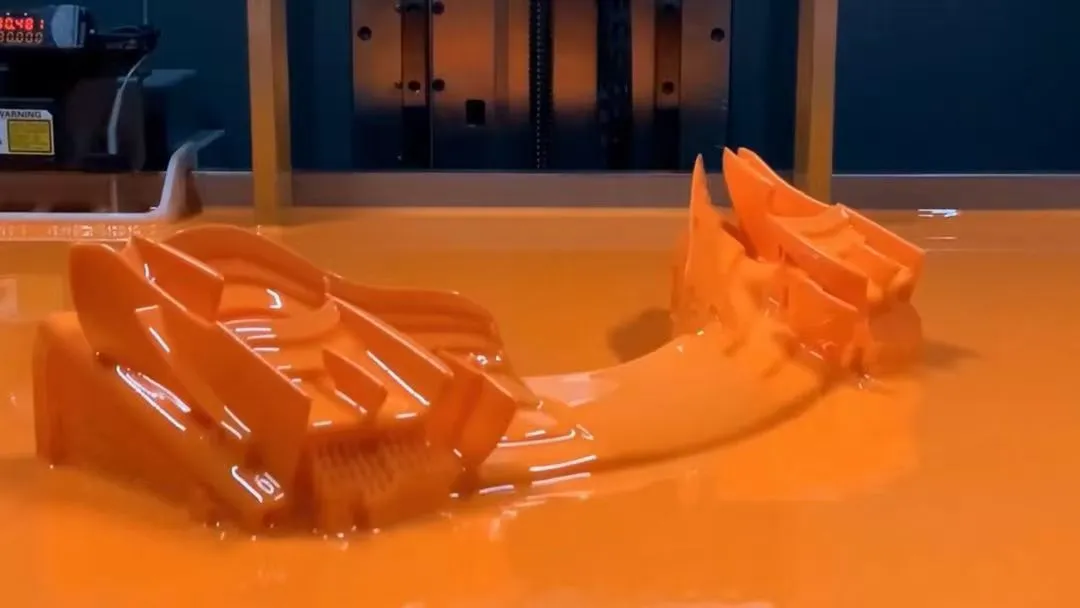
Example: A soft robotic gripper needs flexible resin material with a specific Shore hardness (e.g., 50A). An industrial SLA printer can print that gripper today and install it on the production line tomorrow.
Material Selection Checklist
Ask these questions before choosing a 3D printing material:
- What mechanical properties do I need? (strength, flexibility, impact resistance)
- Will the part be exposed to heat, chemicals, or UV?
- Does it need regulatory certification? (FDA, biocompatible, flame-retardant)
- Can my SLA printer handle the viscosity of this resin?
- Is this 3D printing material available in large quantities for production?
Industrial SLA vs Industrial DLP vs Industrial LCD
When shopping for an industrial 3D printer, you will encounter three main resin technologies. Here is how they compare for large format 3D printing and rapid manufacturing 3D printing.
Comparison Table
| Criteria | Industrial SLA | Industrial DLP | Industrial LCD |
| Light source | Laser | Projector | LCD screen |
| Large format capability | ★★★★★ | ★★ | ★★ |
| Surface finish | ★★★★★ | ★★★★ | ★★★ |
| Speed (small parts) | ★★★ | ★★★★★ | ★★★★ |
| Speed (large parts) | ★★★★ | ★★ | ★★ |
| Material variety | ★★★★★ | ★★★★ | ★★★ |
| Support for flexible resin material | ★★★★★ | ★★★ | ★★ |
| Light source lifetime | 30,000+ hours | 2,000–10,000 hours | 1,000–2,000 hours |
| Total cost of ownership (5 years) | Low | Medium | High (screen replacements) |
Which One Is Right for You?
- Choose industrial SLA if: You need large format 3D printing, engineering-grade 3D printing materials, or flexible resin material capabilities.
- Choose industrial DLP if: You print thousands of very small parts (dental, jewelry) and speed is your only priority.
- Choose industrial LCD if: You are on a tight budget and cannot afford SLA or DLP — but understand the trade-offs.
For most rapid manufacturing 3D printing applications — especially those requiring large format 3D printer capabilities or flexible resin material — industrial SLA is the superior choice.
How to Choose an Industrial SLA Printer
If you have decided that an industrial SLA printer is right for your shop, here are the key specifications to evaluate.
1. Build Volume (True Large Format)
Do not trust theoretical volume. Ask for usable volume — the area where accuracy meets specification.
For large format 3D printing, look for:
- Minimum XY: 400 x 400 mm
- Minimum Z: 400 mm
- Total volume: 50+ liters
2. Laser Configuration
- Single laser: Simpler, lower cost, slower for large parts
- Dual or quad lasers: Faster, better for rapid manufacturing 3D printing, higher cost
3. Material Compatibility
Does the industrial 3D printer support:
- Flexible resin material across Shore hardness range (00A to 80A)?
- High-temperature resins (150°C+)?
- Biocompatible or certified materials for your industry?
- Open or closed material system?
4. Automation for Rapid Manufacturing
For true rapid manufacturing 3D printing, look for:
- Automatic resin dispensing and replenishment
- Automatic part removal (conveyor or robotic)
- Integration with washing and curing stations
- Remote monitoring and predictive maintenance
5. Total Cost of Ownership (TCO)
Do not compare only purchase price. Calculate 3–5 year TCO including:
- Printer cost
- 3D printing materials (per liter)
- Maintenance and replacement parts (laser, optics, screens)
- Labor (post-processing, machine tending)
- Downtime cost
Industrial SLA Printer Recommendations (2026)
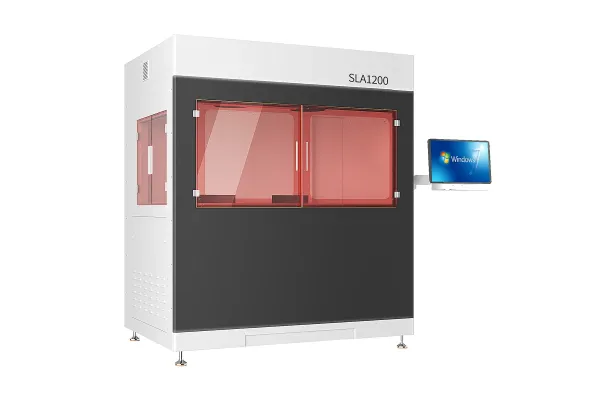
Best Overall: Zongheng3D Industrial SLA
For businesses serious about large format 3D printing and rapid manufacturing 3D printing, Zongheng3D Industrial SLA is our top recommendation.
Why:
- True large format (customizable up to 81700 x 850 x 650 mm)
- Laser SLA technology with 30,000+ hour light source
- Open material system — use any compatible 3D printing material, including all flexible resin material formulations
- 24/7 capable with remote monitoring
- Lower TCO than closed-ecosystem competitors
Best for: Aerospace, automotive, medical, general manufacturing, and any application requiring flexible resin material or large parts.
Best for Small Industrial Parts: 3D Systems Figure 4
The Figure 4 is an industrial DLP system. It is very fast for small parts but lacks large format 3D printer capabilities.
Trade-offs: Small build volume, proprietary materials, less support for flexible resin material.
Best for Entry-Level: Nexa3D XiP Pro
The XiP Pro bridges professional and industrial. It is faster than desktop printers but not a true industrial 3D printer.
Trade-offs: LCD screen replacement required, limited automation, not true large format.
The Future of Industrial SLA and Rapid Manufacturing
The industrial 3D printer market is growing rapidly. Here are three trends to watch.
1. Larger Build Volumes
Large format 3D printer systems are getting larger. In 2026, we are seeing SLA platforms exceed 1,000 mm in XY. This enables one-piece printing of automotive panels, furniture, and even marine parts.
2. Faster Materials Development
New 3D printing materials are being released every month. Flexible resin material formulations now match injection-molded elastomers. High-temperature resins exceed 300°C.
3. Automated Production Cells
The most advanced rapid manufacturing 3D printing setups are fully automated: printing → washing → curing → part removal → next print. This brings 3D printing closer to traditional manufacturing throughput.
Frequently Asked Questions (FAQ)
What is the difference between an SLA printer and an industrial SLA printer?
An SLA printer is any stereolithography machine. An industrial SLA printer is a specific subset designed for 24/7 production, large build volumes, and engineering-grade 3D printing materials.
Can an industrial 3D printer handle flexible resin material?
Yes. In fact, an industrial SLA printer is the best type of industrial 3D printer for flexible resin material. The low peel forces of laser SLA allow reliable printing of soft elastomers (Shore 00A to 80A).
How large can a large format 3D printer be?
Industrial large format 3D printer systems can reach 1,000 x 1,000 x 1,000 mm or larger. However, most applications are served by 500 x 500 x 500 mm platforms.
Is rapid manufacturing 3D printing cheaper than injection molding?
It depends on volume.
- Under 1,000 parts: Rapid manufacturing 3D printing is usually cheaper
- 1,000–10,000 parts: It depends on part complexity
- Over 10,000 parts: Injection molding is cheaper per part
What 3D printing material should I use for functional prototypes?
For functional testing, use tough resin (impact resistance) or flexible resin material (if your part bends). For high-temperature environments, use high-temperature resin.
How much does an industrial SLA printer cost?
- Entry-level industrial: $20,000 – $50,000
- Mid-range industrial: $50,000 – $150,000
- Large format industrial: $150,000 – $500,000+
Do I need a large format 3D printer if I mostly print small parts?
No. If 95% of your parts fit on a desktop SLA printer, you do not need a large format 3D printer. Only upgrade when you consistently need larger parts or batch printing of many small parts.
Conclusion
Choosing the right industrial 3D printer is a major decision. But when you need large format 3D printing, rapid manufacturing 3D printing speed, and advanced 3D printing materials like flexible resin material, the answer is clear.
Key takeaways:
- An industrial SLA printer combines the precision of SLA printer technology with production-grade reliability
- Large format 3D printer systems enable one-piece manufacturing of full-scale parts
- Rapid manufacturing 3D printing is faster and cheaper than traditional methods for low-to-medium volumes
- The right 3D printing material (tough, flexible, high-temp, biocompatible) determines what you can make
- Industrial SLA outperforms DLP and LCD for large parts, material variety, and flexible resin material
If your work involves production of large parts, engineering-grade materials, or flexible resin material, Zongheng3D Industrial SLA is the industrial 3D printer we recommend.