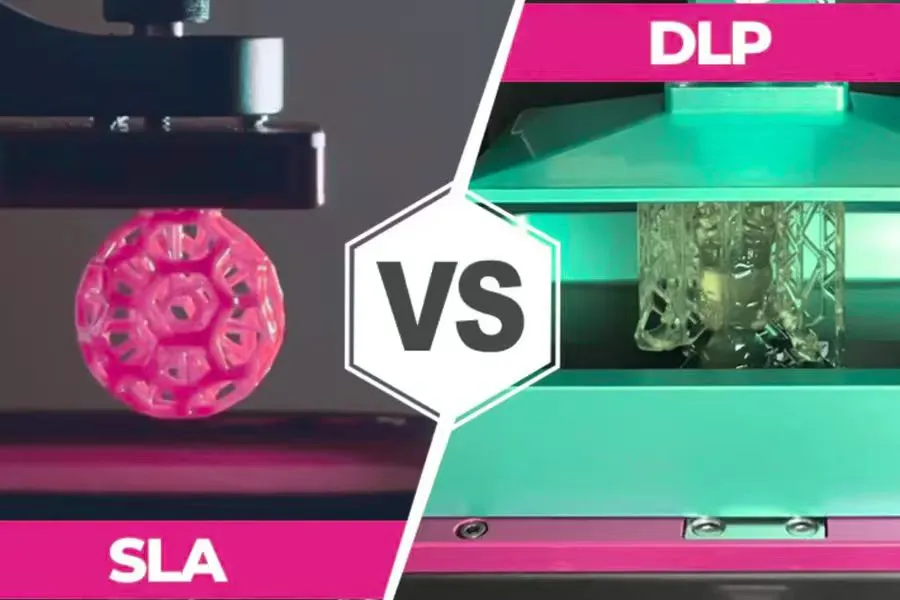
If you are looking for a resin 3D printer, you have probably seen two main technologies: SLA and DLP.
Both use light to turn liquid resin into solid plastic. Both can create highly detailed parts. But they are not the same.
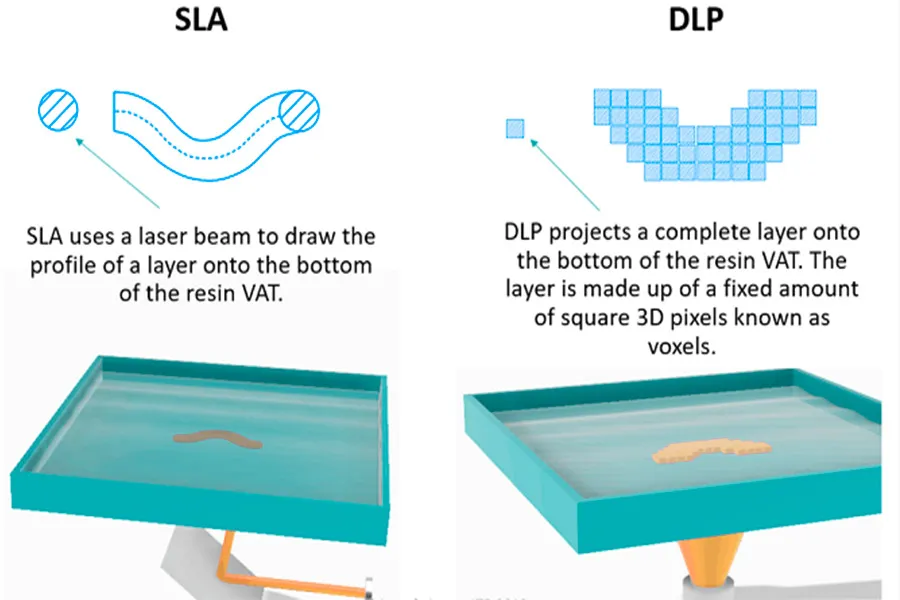
Understanding the difference between SLA vs DLP will help you choose the right printer for your needs — whether you need a professional resin 3D printer for dental models, a resin SLA printer for jewelry, or a fast DLP system for batch production.
In this guide, you will learn:
- How SLA and DLP work
- Key differences in speed, accuracy, and cost
- Which technology works best with flexible resin material
- Real-world applications for each
- How to choose the best resin 3D printer for your workflow
Let’s get started.
What Is SLA 3D Printing?
How Does an SLA Printer Work?
SLA stands for Stereolithography. It was the first 3D printing technology ever invented.
An SLA 3D printer uses a laser to cure liquid resin.
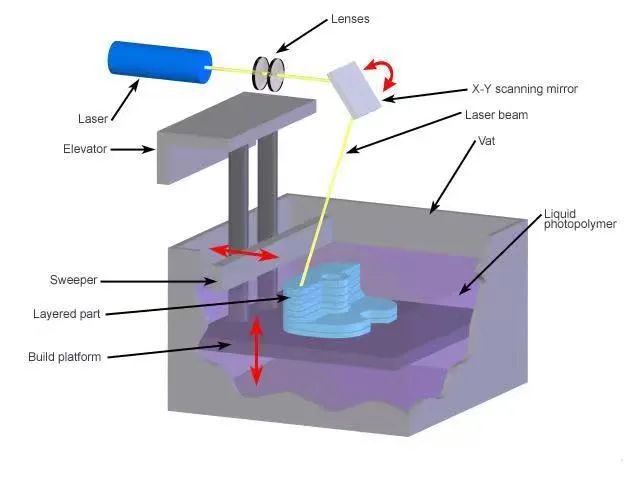
Here is the step-by-step process:
- A build platform lowers into a vat of liquid resin
- A laser traces the first layer pattern point by point
- The resin hardens where the laser hits
- The platform lifts slightly
- Fresh resin flows under the part
- The laser traces the next layer
- This repeats until the print is complete
After printing, the part must be washed in isopropyl alcohol and cured under UV light.
Light Source and Precision
- Light source: Single UV laser
- Beam control: Two moving mirrors (galvanometers)
- Typical spot size: 85–140 microns
- Layer height: 25–100 microns
Because the laser traces each layer point by point, SLA is very precise. This makes it a popular choice for a resin SLA printer in dental and jewelry applications.
Common SLA Printers
Examples of SLA printers include:
- Zongheng3D SLA600
- Formlabs Form 3 / 3L / 4
- Anycubic Photon Mono X (entry-level)
- Prusa SL1S (sometimes classified as SLA-like)
A true SLA 3D printer is laser-based. Do not confuse it with LCD or DLP printers.
What Is DLP 3D Printing?
DLP stands for Digital Light Processing. It was invented in the 1980s for projectors, then adapted for 3D printing.
How Does a DLP Printer Work?
A DLP 3D printer uses a digital projector to flash an entire layer at once.
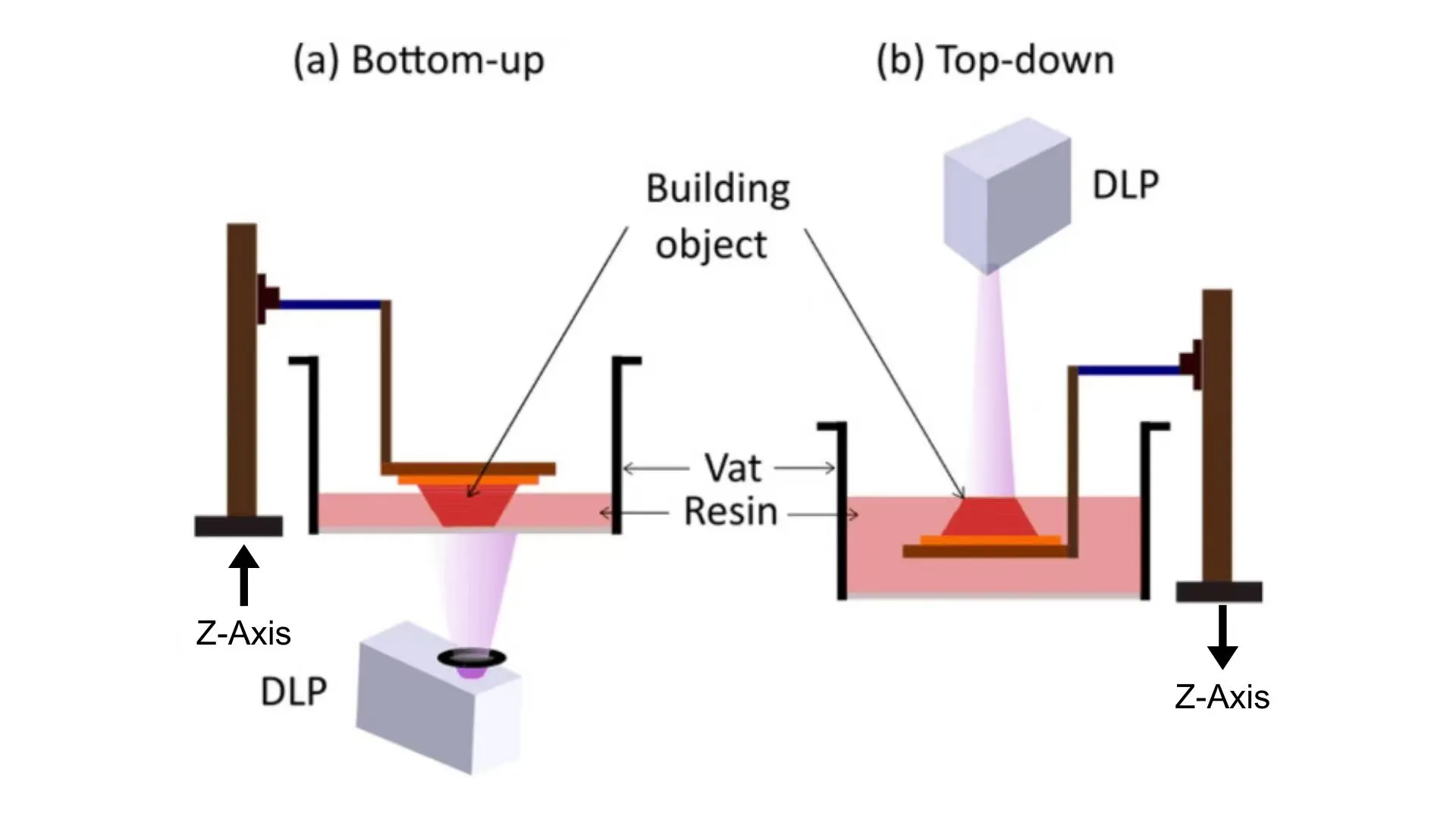
Here is how it works:
- A build platform lowers into a vat of liquid resin
- A projector flashes the entire image of the first layer onto the resin
- The whole layer cures at the same time (not point by point)
- The platform lifts
- The projector flashes the next layer
- This repeats until the print is complete
Like SLA, DLP parts also need washing and post-curing.
Light Source and Speed
- Light source: UV projector (DLP chip + lamp or LED)
- Pixel-based curing: Whole layer cures in one flash
- Layer height: 10–100 microns
- Pixel size: 35–100 microns (depends on projector and distance)
Because DLP cures entire layers at once, it is often faster than SLA — especially for parts with large cross-sections.
Common DLP Printers
Examples of DLP printers include:
- Zongheng3D DLP DM400
- Anycubic Photon Ultra
- Phrozen Sonic Mini (some models)
- Flashforge Hunter
DLP is widely used in dentistry and jewelry manufacturing because of its speed.
Head-to-Head Comparison: SLA vs DLP
Now let us compare SLA vs DLP directly across the most important factors.
Light Source and Curing Method
| Feature | SLA | DLP |
| Light source | Single laser | Digital projector |
| Curing method | Point by point | Whole layer at once |
| Light uniformity | Very good | Very good (with good optics) |
Speed
| Aspect | SLA | DLP |
| Small parts | Similar | Slightly faster |
| Large, solid layers | Slower (laser must trace everything) | Much faster (flash entire layer) |
| Multiple parts | Slower | Much faster |
Accuracy and Surface Finish
| Aspect | SLA | DLP |
| XY resolution | Limited by laser spot size (85–140 µm) | Limited by pixel size (35–100 µm) |
| Surface finish | Very smooth | Smooth, but may show pixel lines |
| Overhangs and details | Excellent | Excellent |
Winner for fine detail: Tie. Both can achieve high precision. DLP can sometimes achieve smaller feature sizes because pixels can be smaller than a laser spot.
Build Volume
| Aspect | SLA | DLP |
| Typical size | Small to medium (up to 30+ cm) | Small to medium |
| Scalability | Easier to scale with bigger lasers/mirrors | More complex (projector resolution and light become limiting) |
Winner: SLA for larger build volumes.
Material Compatibility
Both SLA and DLP use photopolymer resins. However, not all resins work equally well on both.
| Material type | SLA | DLP |
| Standard resin | Yes | Yes |
| Flexible resin material | Yes | Yes(but check viscosity) |
| High-temperature resin | Yes | Sometimes |
| Dental resin | Yes | Yes |
| Castable resin (jewelry) | Yes | Yes |
If you plan to use flexible resin material, both technologies can work. However, very low-viscosity resins may drain differently on DLP vs SLA. Always check the resin manufacturer’s recommendations.
Printer Cost and Maintenance
| Aspect | SLA | DLP |
| Entry-level price | $200 – $500 | $300 – $600 |
| Professional price | $3,000 – $10,000+ | $3,000 – $8,000+ |
| Consumables | Resin, tanks, laser (rare) | Resin, projector (may need replacement) |
| Maintenance | Low (laser lasts years) | Medium (projector optics may degrade) |
A professional resin 3D printer in SLA is often more expensive upfront but may have lower long-term maintenance.
Applications: When to Use SLA vs DLP
When to Choose SLA
Choose an SLA 3D printer when:
- You need very large build volumes
- You prefer a mature, well-supported ecosystem (e.g., Formlabs)
- You print parts that are tall and thin (laser accuracy helps)
- You want a resin SLA printer for one-off, high-value parts
Best industries for SLA:
- Engineering (functional prototypes)
- Jewelry (master patterns)
- Medical (some surgical guides)
- General prototyping
When to Choose DLP
Choose a DLP 3D printer when:
- Speed is your top priority
- You print many small parts at once
- You work in dental manufacturing (mass production of models)
- You want the best resin 3D printer for batch production
Best industries for DLP:
- Dental (aligners, crowns, surgical guides)
- Jewelry (high-volume casting patterns)
- Consumer goods (fast iterations)
- Manufacturing aids (jigs and fixtures)
Real-World Examples
| Application | Recommended tech | Why |
| Single dental crown | DLP | Fast, accurate enough |
| Large anatomical model | SLA | Big build volume needed |
| Flexible gasket (rubber-like part) | Either | Use flexible resin material on both |
| 100 jewelry rings for casting | DLP | Batch speed |
| Engineering prototype with threads | SLA | Excellent laser accuracy |
SLA vs DLP: Which Is the Best Resin 3D Printer for You?
There is no single winner between SLA vs DLP. The best choice depends on your specific needs.
Ask yourself these four questions:
1. How many parts do you print per day?
- 1–5 parts → SLA is fine
- 10–50+ parts → DLP will save you hours per day
2. How important is raw speed?
- Not critical → SLA works well
- Very important → DLP is better
3. What build size do you need?
- Small (< 150 mm) → Both work
- Large (> 200 mm) → SLA is safer
4. Do you use specialized resins like flexible resin material?
- Most resins work on both. But check:
- Flexible resin material: Usually works on both, but some flexible resins may separate faster on DLP vats.
- High-viscosity resins: SLA may handle them better because of the recoating system.
Common Myths About SLA and DLP
Myth 1: “DLP is always more accurate than SLA”
False. Both can achieve 25–50 micron feature sizes. Accuracy depends more on the specific printer than the technology.
Myth 2: “SLA is obsolete”
False. SLA remains the standard for professional resin 3D printer systems, especially for engineering and medical use.
Myth 3: “You cannot use flexible resin material on DLP”
False. Many flexible resin material formulations work perfectly on DLP printers. Just verify with the resin manufacturer.
Myth 4: “DLP projectors need replacement every few months”
False. Modern DLP projectors (especially LED-based) can last thousands of hours.
Conclusion
SLA vs DLP is not about good vs bad. It is about matching the technology to your workflow.
Choose SLA if:
- You need a resin SLA printer for large parts
- You want a proven, laser-based system
- You do not need maximum speed
Choose DLP if:
- Speed is your priority
- You print many small parts in batches
- You work in dental or high-volume jewelry manufacturing
Both technologies can use flexible resin material, standard resins, and specialty materials. Both can produce stunning parts.
If you are still unsure, start with a low-cost printer from either category. Experience will teach you what matters most for your work.
Next Steps
If you are ready to buy a resin 3D printer, here is a simple checklist:
- Define your typical part size
- Estimate how many parts you print per week
- Check which resins you need (flexible resin material, tough, castable, etc.)
- Compare SLA and DLP models in your budget
- Read reviews from users in your industry
For professional resin 3D printer users, also consider:
- Warranty and support
- Resin ecosystem (first-party vs third-party resins)
- Post-processing equipment (washing and curing stations)