The humanoid robotics industry is moving from prototype demonstrations to mass production. Companies are racing to build robots that can walk, run, and manipulate objects with human-like dexterity. This shift demands a fundamental change in how robot components are manufactured.
Humanoid robots require parts that are simultaneously lightweight, strong, heat-resistant, and aesthetically refined. Traditional manufacturing methods like CNC machining and injection molding struggle to meet these demands, especially when designs are complex and iteration cycles are measured in weeks, not days.
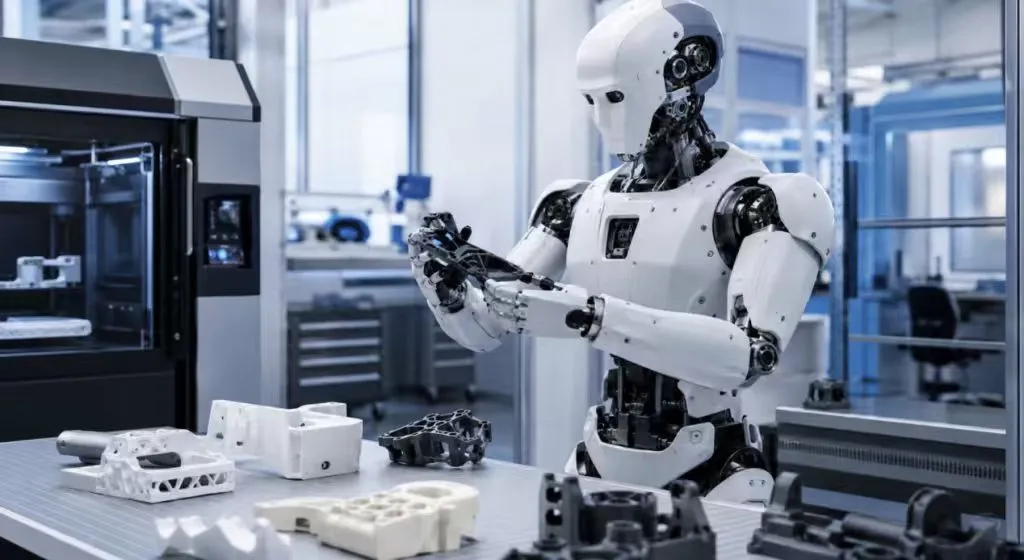
Selective Laser Sintering (SLS) is emerging as a solution to these challenges. This industrial 3D printing technology enables lightweight structures, complex geometries, and rapid design iteration without the cost and delay of traditional tooling.
This article explores how SLS 3D printing addresses the core challenges of humanoid robot manufacturing, with a specific focus on the Zongheng3D SLS3540 Pro — an industrial SLS printer built for precision, scale, and production efficiency.
The Manufacturing Challenges of Humanoid Robots
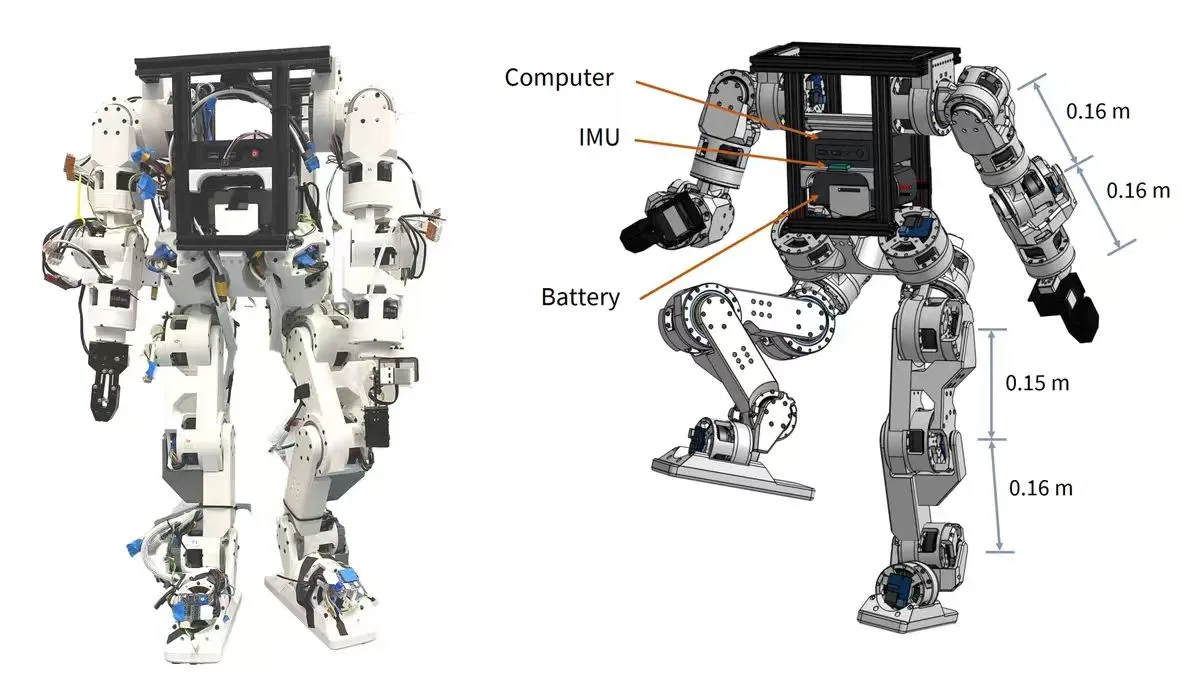
Humanoid robots push the limits of mechanical engineering. Every component must perform reliably under dynamic loads while remaining as light as possible.
Weight Constraints
Every kilogram of robot weight affects energy consumption, movement agility, and battery life. Lightweighting is not optional — it is essential for practical, commercially viable humanoid robots
Complex Geometries
Humanoid robots require intricate structures: bionic skeletons, multi-sensor integration cavities, topology-optimized frames, and lattice-filled components. These shapes are difficult or impossible to produce with traditional machining or molding
Rapid Iteration Cycles
The robotics R&D process involves frequent design changes. Traditional mold-based manufacturing punishes iteration — each design change requires new tooling, adding weeks and thousands of dollars
Strength and Durability
Robot structural components must withstand continuous impact loads from walking, jumping, and high-frequency joint movements. Parts need consistent mechanical properties in all directions to ensure reliability under dynamic stress
Production Scalability
As humanoid robots move from prototypes to production, manufacturers need manufacturing processes that scale efficiently — from low-volume testing to batch production — without high upfront costs
How SLS 3D Printing Solves These Challenges
SLS (Selective Laser Sintering) uses a laser to sinter powdered polymer materials into solid parts, layer by layer. Unlike other 3D printing technologies, SLS requires no support structures because unsintered powder naturally supports the part during printing.
This fundamental advantage enables capabilities that align directly with humanoid robot manufacturing needs.
Lightweighting Through Topology Optimization
SLS enables the creation of intricate lattice structures that reduce weight without sacrificing strength. By using topology optimization — algorithm-driven design that removes material where it is not structurally needed — engineers can achieve strength-to-weight ratios that are difficult with traditional manufacturing.
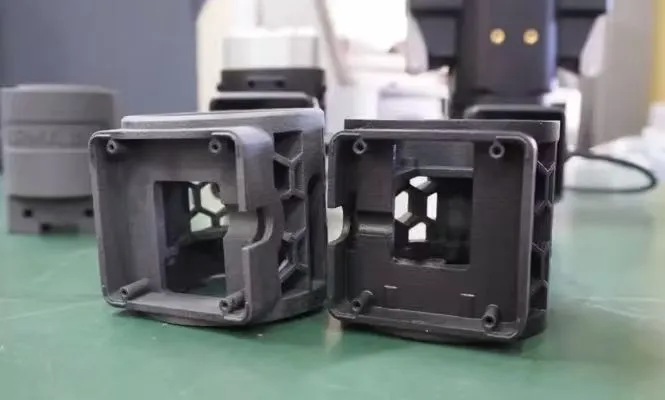
Industry case studies show that SLS-printed structural components can achieve weight reductions of 30 to 50 percent compared to conventional parts, while maintaining excellent mechanical properties.
Support-Free Complex Geometry
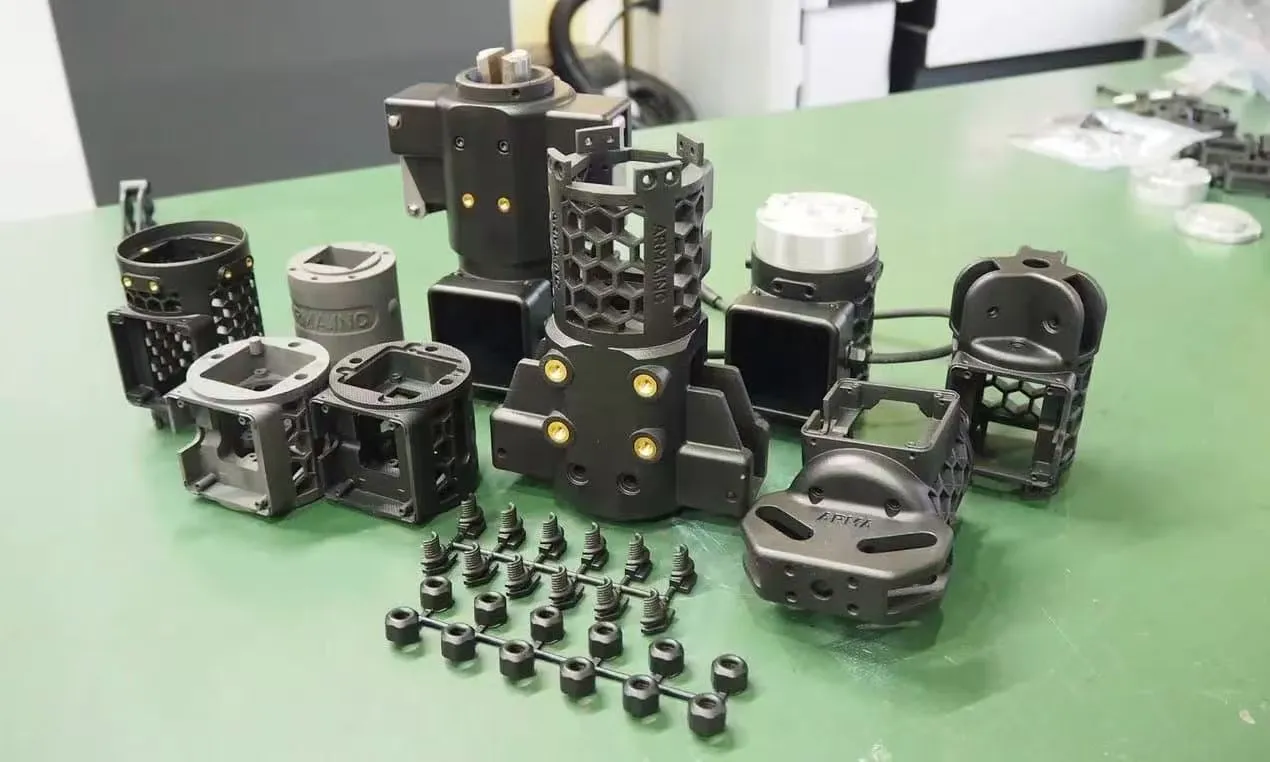
For humanoid robots, complex shapes are the norm: hollow limbs, internal channels for wiring, organic bionic forms, and multi-sensor housings. SLS prints these geometries directly with no support structures, simplifying post-processing and enabling designs that are difficult or impossible with CNC machining or injection molding.
Rapid Iteration Without Tooling
SLS eliminates the need for expensive molds. A design change can be implemented in CAD and printed the same day — compressing development cycles from weeks to hours.
Consistent Mechanical Properties
SLS produces parts with excellent isotropic strength — consistent mechanical properties in all directions, including the Z-axis. For load-bearing components that experience multi-directional loads during robot operation, this consistency is critical.
Scalable Production
SLS scales efficiently from prototypes to production. A single SLS build can produce dozens of parts simultaneously, making it suitable for both low-volume testing and batch production.
Key Components Printed with SLS for Humanoid Robots
Based on real-world robotics projects, SLS technology is being used to manufacture several categories of robot components.
Structural Frames and Load-Bearing Parts
For load-bearing components like leg shells and torso frames, SLS-printed nylon provides the rigidity, dimensional stability, and durability required for reliable robot operation.
In a recent humanoid robot development project, leg shells and structural parts were successfully printed using SLS nylon. The components maintained precise dimensions for complex assembly while offering the strength needed for dynamic movement testing.
Flexible Components and Impact Protection
TPU and other flexible materials printed via SLS are used for cushioning elements, shoe soles, and impact-absorbing structures. These materials withstand repeated impacts while maintaining shape and performance.
Grippers and End Effectors
SLS printing enables rapid production of custom grippers with complex geometries. Researchers have developed media-free grippers using SLS technology — weighing only 50 grams, these grippers operate without external energy sources and have been tested with objects weighing up to 100 grams.
The monolithic design using compliant mechanisms allows movement through elastic deformation instead of conventional joints.
Multi-Sensor Integration Housings
Robots integrate cameras, LiDAR, microphones, and other sensors. SLS can produce complex housings with integrated mounting features and internal channels for wiring — consolidating multiple components into one printed part.
Advanced Materials for Robotics: PEBA and Beyond
Recent developments in SLS materials are expanding possibilities for humanoid robotics.
PEBA Material Properties
PEBA (Polyether Block Amide) is a high-performance thermoplastic elastomer gaining attention in robotics. It is composed of rigid polyamide hard segments and flexible polyether soft segments, offering a unique balance of properties.
According to industry material testing, PEBA demonstrates excellent elastic recovery and maintains its mechanical properties through extensive bending cycles. Its relatively low base density contributes to weight reduction, particularly when combined with foaming technologies.
Why PEBA Matters for Robotics
Reports indicate that foamed PEBA components can achieve substantial weight savings compared to conventional TPU, with high energy return rates that are attractive for dynamic robotic applications.
The material also enables the production of complex lattice structures — including auxetic geometries with negative Poisson’s ratio — for applications such as collision protection and flexible gripping components.
Real-World Success: SLS in Humanoid Robot Development
A concrete example demonstrates the impact of SLS technology in humanoid robotics.
Project Context
For the WAIC 2024 World Artificial Intelligence Conference, a humanoid robot project required a full-scale prototype with parts that were lightweight, heat- and wear-resistant, rigid, and aesthetically appealing — all under an extremely tight schedule.
Solution and Results
Using SLS 3D printing, the project team produced leg shells, structural components, and flexible shoe soles within a compressed timeline.
Key outcomes:
- Weight reduction of approximately 30 percent — improved movement flexibility and agility
- Assembly completed ahead of exhibition deadline — demonstrating accelerated manufacturing
- Consistent surface finish between flexible and rigid components
- Future scalability — design iterations can be quickly reproduced and improved.
This project illustrates how SLS technology enables robotics companies to balance performance, aesthetics, and speed in product development.
Why Choose Zongheng3D SLS3540 Pro for Robotics Manufacturing
The Zongheng3D SLS3540 Pro is an industrial-grade SLS printer designed for demanding applications — including humanoid robotics manufacturing.
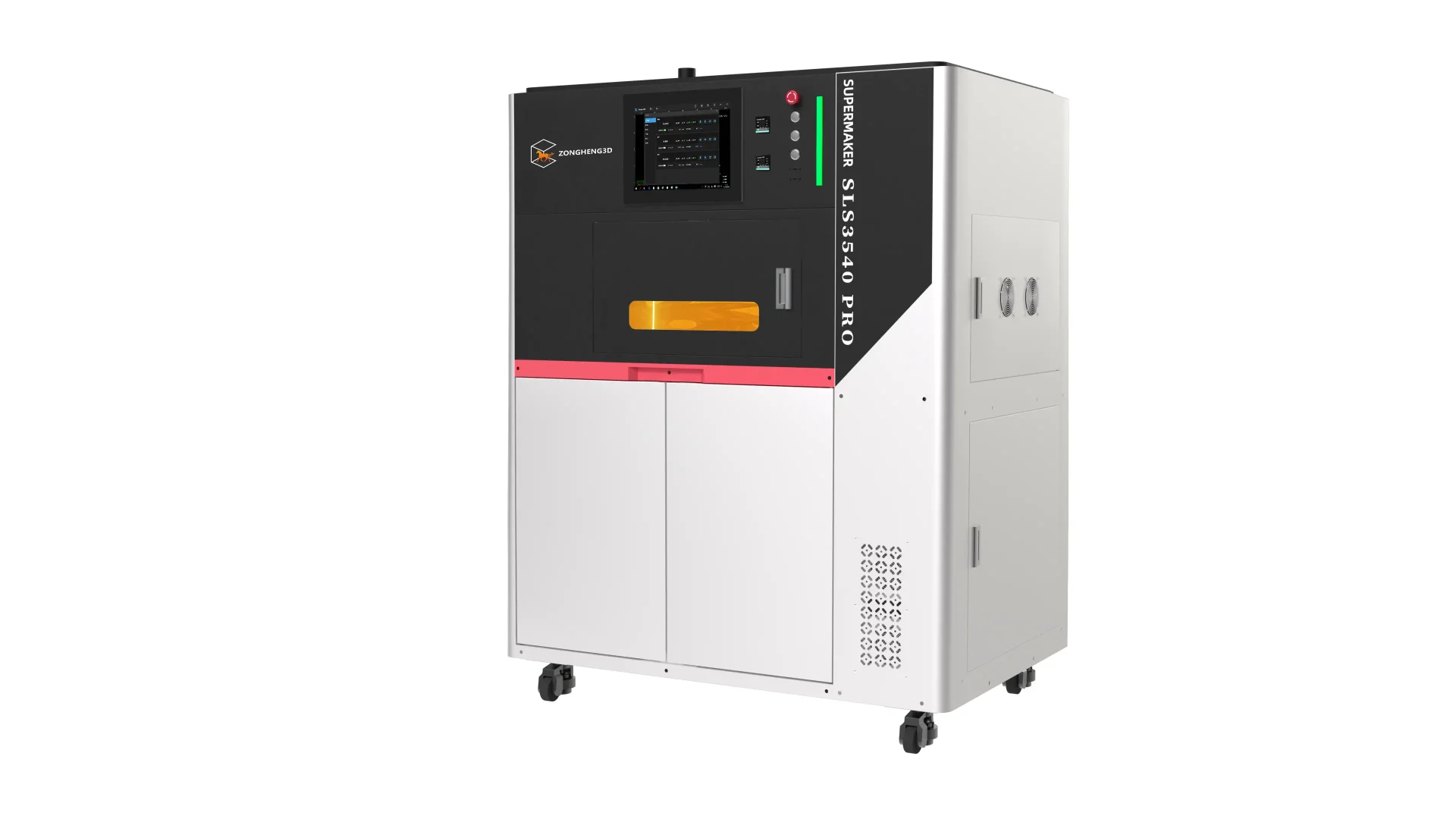
Key Specifications
| Specification | Zongheng3D SLS3540 Pro |
| Technology | Selective Laser Sintering (SLS) |
| Build volume | 350 x 350 x 400 mm |
| Layer thickness | 0.1 – 0.3 mm |
| Weight | 750 kg |
| Applications | Robotics, manufacturing, medical, aerospace, education |
Why the SLS3540 Pro Is Ideal for Robotics
Precision and Accuracy: With ±0.2 mm dimensional accuracy, the SLS3540 Pro produces parts that fit together reliably in complex robotic assemblies.
Large Build Volume: The 350 x 350 x 430 mm build volume allows for printing multiple robot components in a single batch — reducing per-part cost and accelerating production timelines.
Material Versatility: The SLS3540 Pro supports high-performance materials including nylon, glass-filled nylon, and TPU. This enables manufacturing of both rigid structural parts and flexible protective components on a single platform.
Efficient Production: The system is designed for powder utilization that minimizes material waste and lowers per-part costs — essential for robotics companies balancing R&D and production budgets.
Proven in Industry: Zongheng3D’s equipment is deployed in manufacturing, medical, and industrial applications, demonstrating reliability in production environments
Frequently Asked Questions
How does SLS achieve lightweighting for robots?
SLS enables topology-optimized lattice structures that remove material where it is not structurally needed. Weight reductions of 30 to 50 percent have been documented in real robotics projects.
What materials work best for humanoid robot structural parts?
PA12 nylon and glass-filled nylon are common for structural components due to their rigidity, impact resistance, and dimensional stability. TPU and PEBA are used for flexible and impact-absorbing components.
Is SLS suitable for production or only prototyping?
Both. SLS is equally effective for rapid prototyping and small-batch production. Industrial SLS systems like the Zongheng3D SLS3540 Pro are designed for scalable production workflows.
Can SLS print flexible materials?
Yes. SLS printers can process TPU and PEBA materials, enabling flexible components like impact protection, shoe soles, and grippers.
What are the cost benefits of SLS for robotics manufacturing?
SLS eliminates mold costs, reduces material waste (with powder recycling strategies), and enables batch production that reduces per-part costs — making it cost-effective for both R&D and production.
How accurate are SLS-printed robot components?
Industrial SLS systems achieve ±0.2 mm dimensional accuracy, ensuring components fit reliably in complex robotic assemblies.
Conclusion
Humanoid robotics is entering an era of mass production. The companies that succeed will adopt manufacturing technologies capable of delivering lightweight, complex, production-ready components — fast.
SLS 3D printing has emerged as a solution that meets these demands. Its ability to produce strong, lightweight parts with complex geometries, without tooling and with rapid iteration, makes it valuable for humanoid robot development.
The Zongheng3D SLS3540 Pro offers the precision, build volume, and material versatility required for robotics manufacturing. With its ±0.2 mm accuracy, 350 x 350 x 400 mm build capacity, and support for both rigid and flexible materials, it is a versatile production tool for the next generation of humanoid robots.