Footwear manufacturing is undergoing a digital transformation. Traditional shoe production involves over 20 separate processes—cutting, stitching, injection molding, and assembly—often taking weeks from design to finished product. The market for 3D-printed footwear reached approximately $4.95 billion in 2026 and is projected to exceed $13 billion by 2032, driven by demand for personalization, performance, and sustainability .
Selective Laser Sintering (SLS) with TPU powder is at the center of this shift. Unlike resin-based or filament-based 3D printing, SLS TPU produces flexible, durable, and breathable components that can be customized to individual foot anatomy without molds or tooling.
This article explores how SLS TPU is being applied to footwear and insoles, from performance midsoles to medical-grade orthotics, and what makes it a production-ready technology for the industry.
Why TPU for Footwear and Insoles?
TPU (Thermoplastic Polyurethane) is a high-performance elastomer already widely used in shoe manufacturing for midsoles, outsoles, and upper components. Its properties make it particularly well-suited for SLS printing.
Elasticity and Energy Return
TPU delivers excellent rebound and compression recovery. It withstands repeated compression and bending deformation, returning quickly to its original shape. This provides durable cushioning and energy feedback—critical for performance footwear.
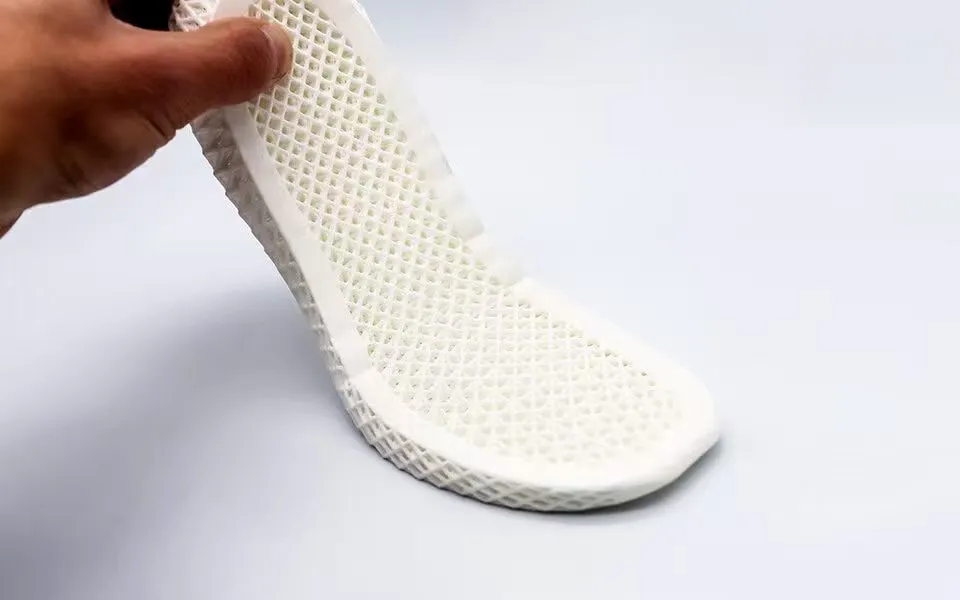
For insoles, TPU’s elasticity allows precise, graded support across different zones of the foot. The arch area can be denser and more supportive; the heel can be more open and cushioned.
Abrasion Resistance and Durability
TPU’s wear resistance far exceeds traditional EVA foam, ensuring that insoles and midsoles maintain their shape and function over extended use . TPM3D’s internal testing of SLS PEBA (a related elastomer) showed a compression set of 22%–26% with zero irreversible deformation after 200,000 dynamic flex cycles.
Breathability Through Lattice Desig
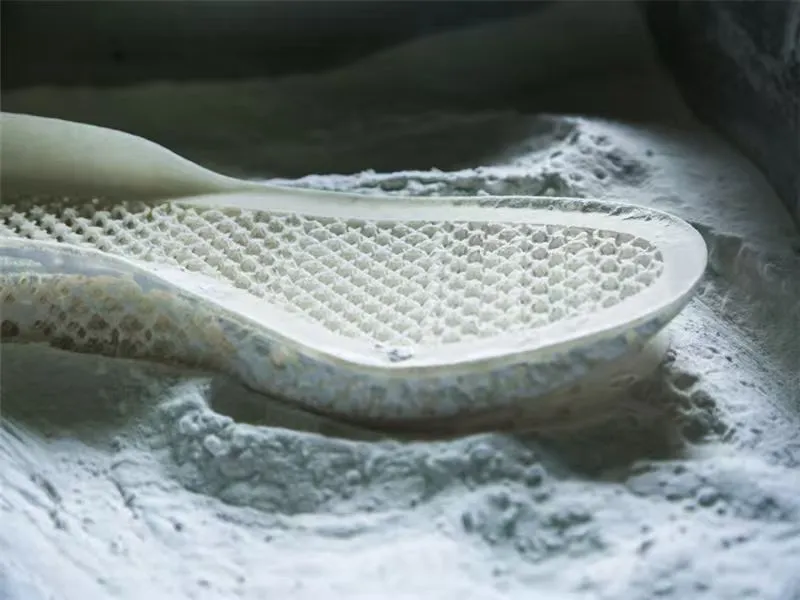
SLS enables complex lattice structures with interconnected voids. These open channels allow air to flow freely through the insole, solving the heat and moisture retention problems of traditional closed-cell foam.
How SLS TPU Works for Footwear Components
SLS uses a laser to sinter TPU powder particles layer by layer into a solid structure . Unlike FDM or SLA, SLS requires no support structures—the unsintered powder bed naturally supports the part during printing.
This support-free process unlocks design freedom that traditional manufacturing cannot match:
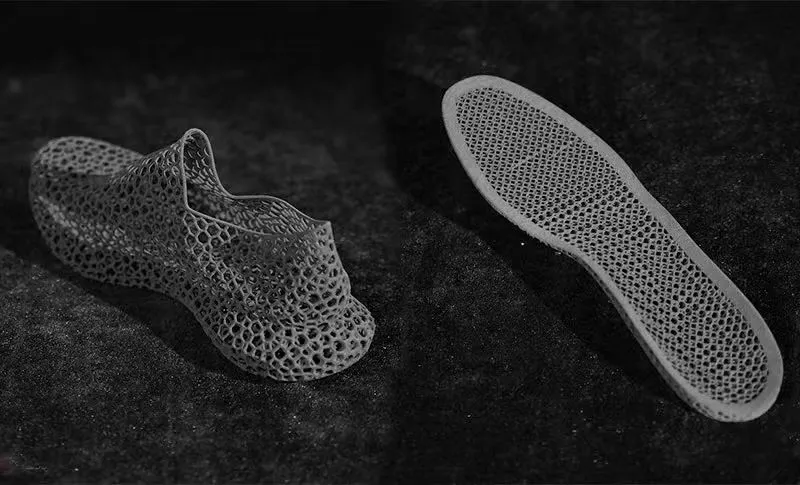
Complex lattice geometries: Unit cell types, strut diameters, and porosity can be tuned to control stiffness, cushioning, and flexibility in different zones
Integrated features: Soles, insoles, and midsole components can be printed as single, unified pieces without assembly
No mold constraints: Digital design eliminates tooling, enabling rapid iteration and on-demand production
TPM3D’s SLS footwear solution compresses traditional multi-step manufacturing into three steps—scanning, design, and printing—reducing production time for a single shoe to as little as 25 minutes.
Applications in Performance Footwear
3D-Printed Midsoles
Midsoles are the most common SLS TPU application in footwear. A printed lattice midsole replaces the cushioning usually provided by foam, with tunable density and geometry for specific performance characteristics.
TPM3D’s Precimid TPU materials offer excellent resilience and durability. Their P550DL dual-laser SLS printer processes powder at 0.15 mm layer thickness and 22 m/s scanning speed, producing up to 90 shoes per 38-hour build cycle.
Custom-Fit Shoe Uppers and Soles
The Print 001XT, a Red Dot Design Award concept, demonstrates the full potential of SLS TPU. It is a fully 3D-printed parametric shoe created with SLS TPU, designed to respond to foot scans and pressure mapping. A single flexible mesh and its offset counterpart create volumetric connecting grids that completely change the shoe’s aesthetic and performance.
Sustainable, On-Demand Production
SLS TPU powder is recyclable, and unused powder can be reused in subsequent builds . End-of-life shoes can be crushed and re-granulated, re-entering the production cycle as raw material . This supports circular economy goals and reduces the waste associated with traditional shoe manufacturing.
Applications in Custom Insoles and Orthotics
The 3D-printed insoles market is expected to reach $269 million by 2032, growing at 12.6% CAGR. SLS is the largest technology segment, holding approximately 50% share, with medical use accounting for 87% of applications.
How SLS TPU Insoles Are Made
The process begins with a 3D scan of the foot and plantar pressure analysis. The digital model is designed with zone-specific lattice structures—denser and stiffer in the arch, more open and cushioned in the heel. SLS printing then produces the fully personalized insole from TPU powder.
TPU88A and TPU90A materials are commonly used for insoles, offering excellent cushioning, impact absorption, and heat and water resistance.
Clinical Benefits
Research on SLS-printed TPU height-increasing insoles for leg length discrepancy showed that after wearing the insoles, patients experienced reduced pain (lower VAS scores), improved foot function (higher Maryland scores), and reduced vertical ground reaction force in both lower limbs. The insoles improved coordination of lower limb movement and reduced ground impact .
SLS TPU insoles help alleviate lower-limb pain caused by conditions including cerebral palsy, diabetic foot, and pronation, while correcting lower-limb alignment and improving gait biomechanics.
Advantages Over Traditional Insoles
| Feature | SLS TPU Insole | Traditional EVA Insole |
| Elasticity tuning | Precise, zone-by-zone lattice control | Limited to material density |
| Breathability | Open lattice structure | Closed-cell foam, poor airflow |
| Durability | High abrasion resistance, long fatigue life | Permanent deformation over time |
| Customization | Full digital workflow, no molds | Manual or CNC, labor-intensive |
Why SLS Outperforms Other 3D Printing for Footwear
SLS vs FDM for Footwear
FDM-printed TPU footwear suffers from visible layer lines and weak interlayer bonding. SLS produces parts with near-isotropic mechanical properties—consistent strength in all directions—and a uniform surface finish . SLS-printed shoes are lighter, more flexible, and more durable than FDM-printed footwear .
SLS vs DLP/SLA for Footwear
DLP and SLA produce fine detail but rely on photopolymer resins, which have limited fatigue resistance and energy return compared to TPU. SLS TPU delivers superior rebound and durability for high-performance applications.
Production Scalability
SLS powder beds allow dense nesting—multiple parts can be produced in a single build. The P550DL can produce 90 shoes per 38-hour cycle . This scalability makes SLS viable for small-batch and on-demand production, not just one-off prototypes.
Frequently Asked Questions
What TPU materials are used for SLS footwear?
Common materials include TPU 88A and TPU 90A, offering hardness ranges of 88–90 Shore A, tensile strength of 7–8 MPa, elongation at break of 130–270%, and excellent fatigue resistance . TPM3D also offers PEBA for high-performance athletic footwear, with compression set of 22%–26% and zero irreversible deformation after 200,000 flex cycles.
Can SLS TPU insoles be customized for medical conditions?
Yes. SLS TPU insoles are used for flat feet, high arches, plantar fasciitis, overpronation, diabetic foot, and leg length discrepancy. The digital workflow enables precise, zone-specific support based on individual foot scans and pressure mapping.
How does SLS TPU compare to injection-molded EVA for insoles?
SLS TPU offers superior elasticity control, breathability through open lattice structures, and better long-term durability. Traditional EVA foam has closed-cell structure (poor airflow) and deforms permanently over time .
Is SLS TPU production sustainable?
Yes. Unused TPU powder is highly recyclable, and end-of-life shoes can be regranulated into new raw material. The process is low-waste and produces no toxic additives or organic solvents.
What is the production speed for SLS TPU footwear?
TPM3D’s SLS footwear solution reduces production time for a single shoe to as little as 25 minutes. The P550DL can produce up to 90 shoes in a single 38-hour build cycle.
Conclusion
SLS TPU is transforming footwear and insole manufacturing by enabling flexible, durable, and breathable components that can be customized to individual anatomy. The technology eliminates molds, reduces production time, and supports sustainable, on-demand manufacturing.
From performance midsoles with tunable lattice structures to medical-grade custom orthotics, SLS TPU delivers mechanical performance and design freedom that traditional foam and other 3D printing technologies cannot match.