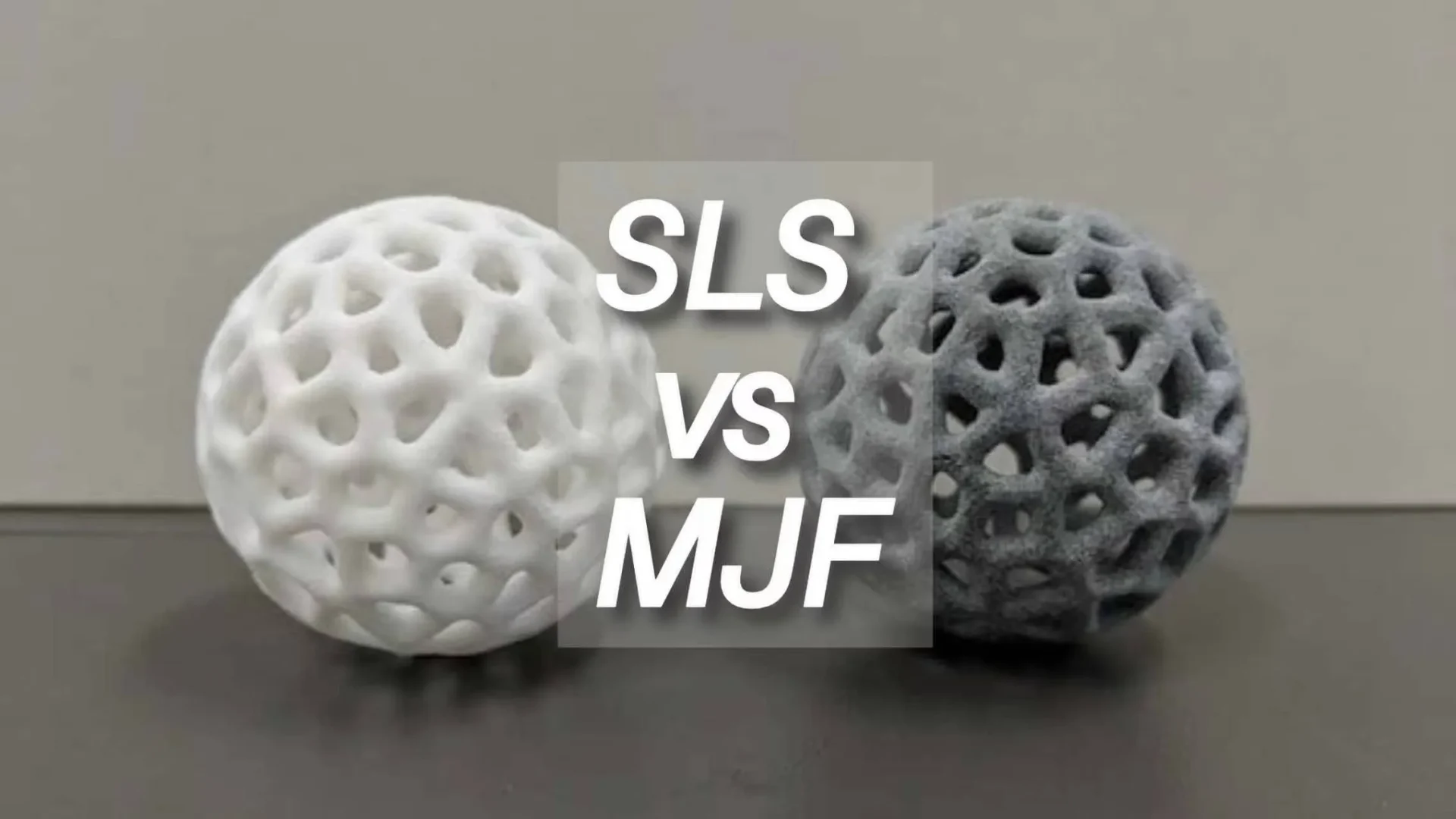
If you are in the market for industrial 3D printing, you have likely heard of two major technologies: SLS and MJF.
SLS stands for Selective Laser Sintering. It has been around since the 1980s. MJF stands for Multi Jet Fusion. It was introduced by HP in 2016 and quickly became a major competitor.
Both are powder bed fusion technologies. Both work with nylon and other polymers. Both produce strong, functional parts without support structures. But they work very differently. And those differences matter for speed, cost, surface finish, and mechanical properties.
This guide will help you understand sls vs mjf. You will learn how each technology works, what materials they use, and which one is right for your application.
Whether you are looking for a selective laser sintering 3d printer or a multi jet fusion printer, this article will give you the answers you need.
SLS in Brief: Key Facts for Comparison
Since you are reading a comparison article, you likely already know the basics of SLS. This section provides only the key facts needed to understand how SLS differs from MJF.
What SLS Does
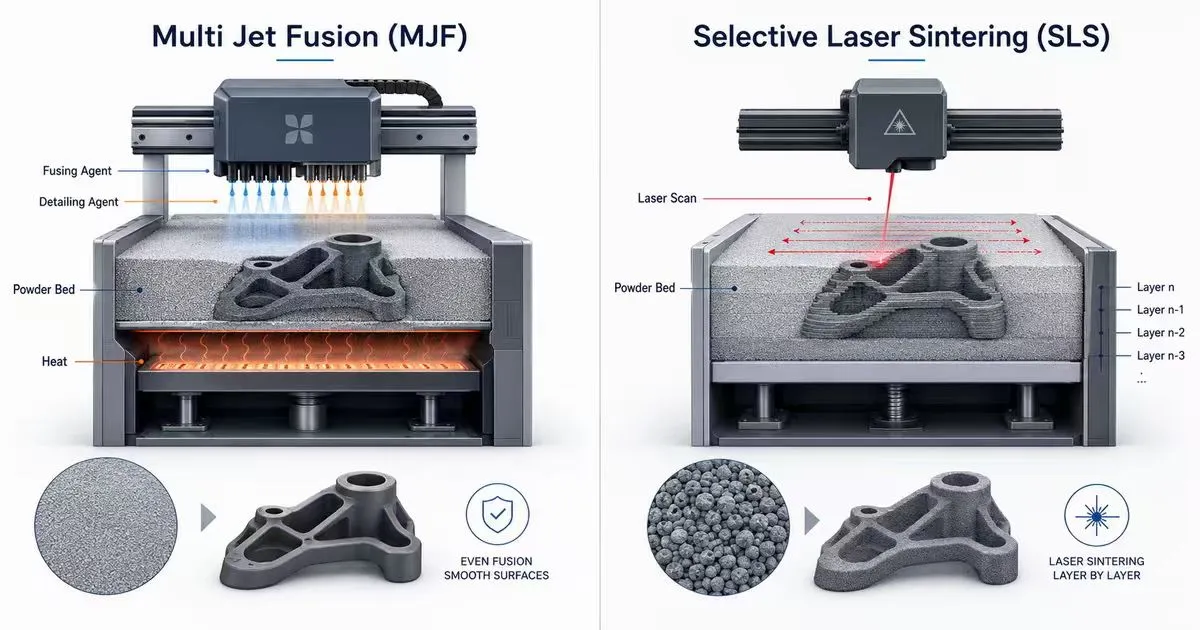
An sls 3d printer uses a laser to sinter powdered nylon. Sintering means heating the powder just enough to fuse particles at the surface, without full melting.
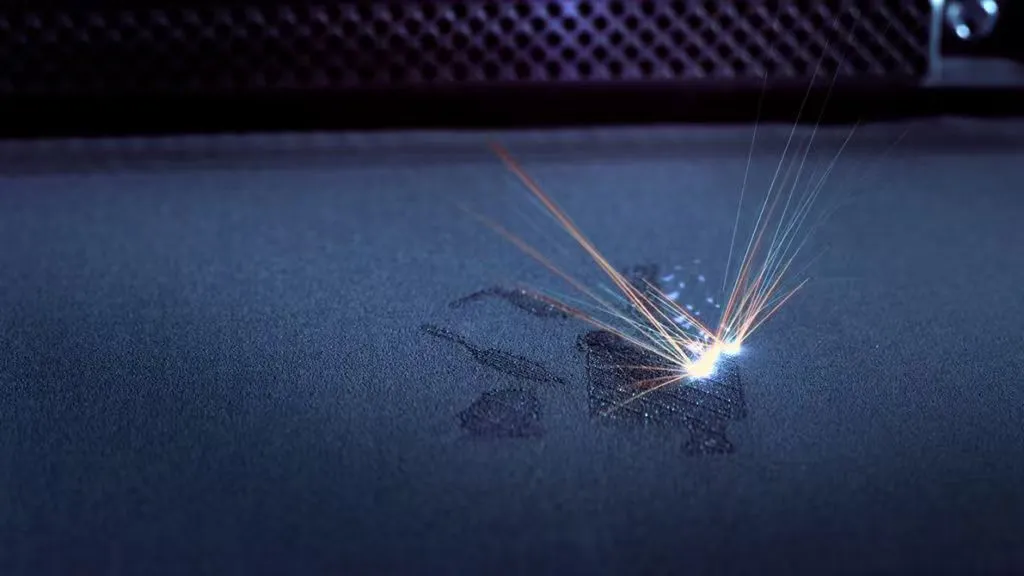
The laser traces each layer point by point. Unused powder supports the part during printing, so no support structures are needed.
SLS at a Glance
| Feature | SLS |
| Heat source | Single laser (point by point) |
| Typical materials | Nylon PA12, PA11, glass-filled, TPU |
| Best for | Low to medium volume, prototypes, TPU parts |
| Machine price range | $10,000 to $300,000 |
When SLS Excels
A selective laser sintering 3d printer is the right choice when:
- You need TPU or flexible materials (MJF has limited TPU support)
- Your volume is under 500 parts per month
- Your budget is under $100,000
- You want a desktop powder bed fusion system
For a complete introduction to SLS technology, including step-by-step process details and material options, see our full guide: What Is SLS 3D Printing?
Now let us compare SLS directly to MJF.
What Is MJF 3D Printing?
MJF stands for Multi Jet Fusion. It was developed by HP and is a newer powder bed fusion technology.
How an MJF Printer Works
An mjf 3d printer works very differently from an sls printer. Instead of a laser, it uses an inkjet array.
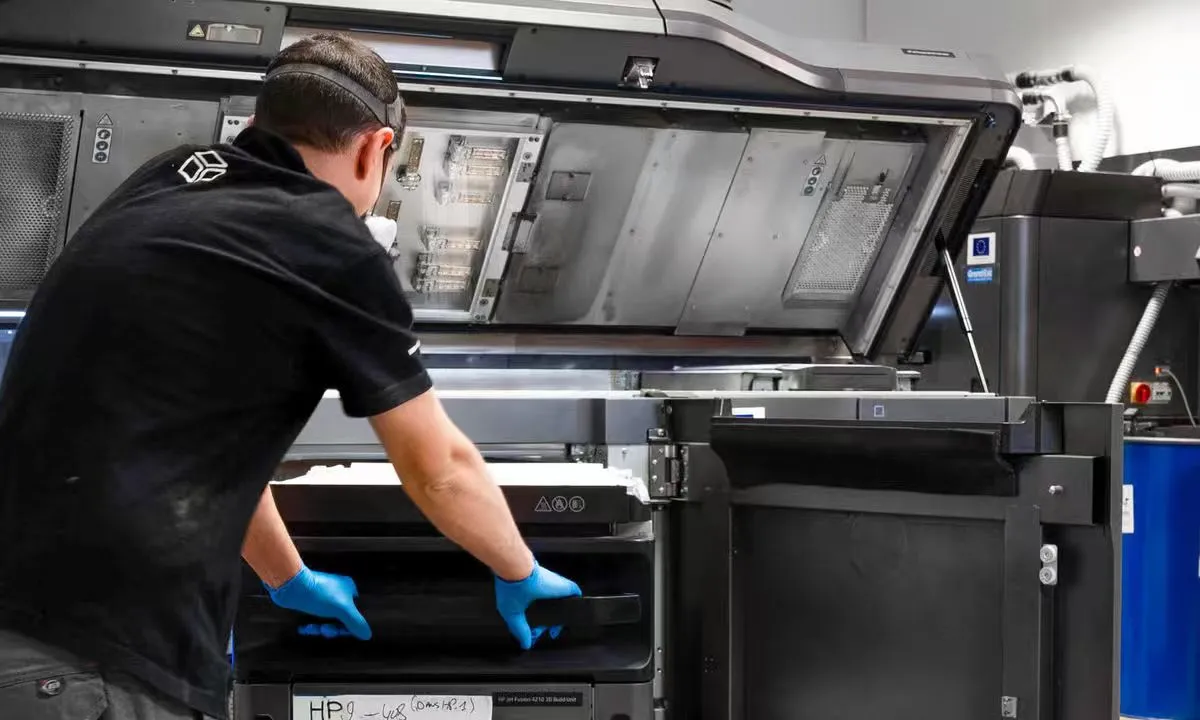
Here is the step-by-step process.
A thin layer of powder is spread across a build platform. An inkjet array moves across the powder, depositing two key agents. One agent is called fusing agent. It helps the powder absorb heat. The other is called detailing agent. It helps define sharp edges and smooth surfaces.
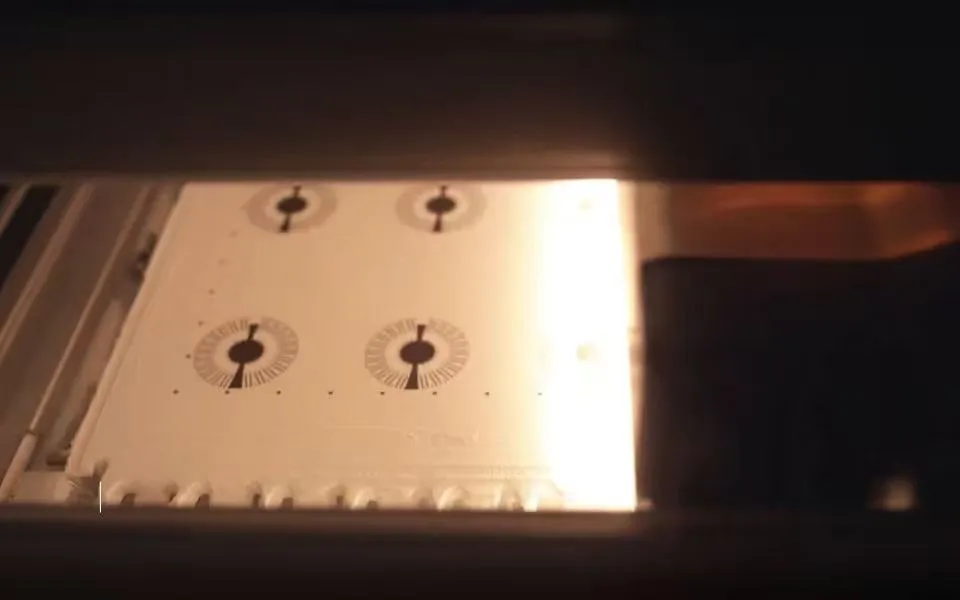
Then a heating lamp passes over the entire layer. The areas with fusing agent melt and fuse together. The areas without fusing agent remain loose powder. The platform lowers. Fresh powder is spread. The process repeats.
Because MJF fuses entire layers at once, it is often faster than SLS.
Materials Used in MJF
A multi jet fusion printer is primarily used with:
- Nylon PA12
- Nylon PA11
- Glass-filled nylon
- TPU (limited compared to SLS)
HP has also developed specialized materials for MJF, including bio-based nylons and flame-retardant grades.
Common MJF Printers
Examples of mjf 3d printer systems include:
- HP Jet Fusion 3200 (entry-level production)
- HP Jet Fusion 4200
- HP Jet Fusion 5200 (high-volume production)
- HP Jet Fusion 5420W (for white parts)
Unlike SLS, MJF is almost exclusively an industrial technology. There is no desktop multi jet fusion printer.
Head-to-Head: SLS vs MJF
Now let us directly compare sls vs mjf across the most important factors for buyers.
Core Technical Difference
| Aspect | SLS | MJF |
| Heat source | Laser (point by point) | Heating lamp + inkjet agents (full layer) |
| Fusing method | Laser sinters powder directly | Fusing agent absorbs heat, melts powder |
| Layer curing | Single point moves across layer | Entire layer fused simultaneously |
| Technology age | 1980s (mature) | 2016 (newer) |
The fundamental difference between sls and mjf is how heat is applied. SLS uses a precise laser. MJF uses chemical agents and broad heat.
Speed and Throughput
| Aspect | SLS | MJF |
| Single part speed | Slower | Faster for dense packing |
| Batch processing | Good | Excellent (full layer curing) |
| Warm-up time | Longer | Shorter |
| Cool-down time | Longer (slow cooling prevents warping) | Shorter |
| Overall throughput | Moderate | High |
For batch production, a multi jet fusion printer is generally faster than an sls printer. MJF can print multiple parts in the same time that SLS prints one, especially when the build plate is densely packed.
Part Quality and Surface Finish
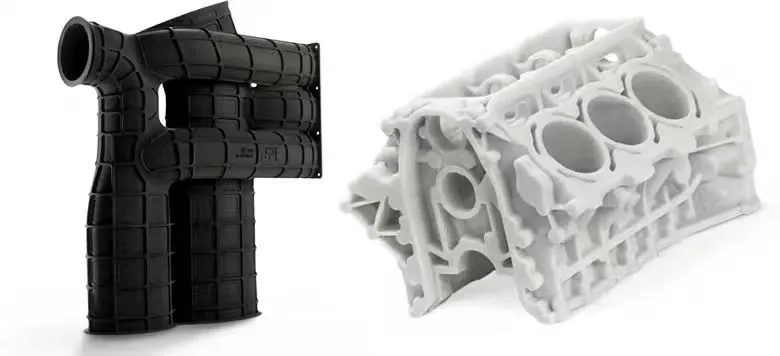
| Aspect | SLS | MJF |
| Surface finish | Slightly rough, grainy | Smoother, more uniform |
| Detail resolution | Very good (laser spot size 100-200 microns) | Excellent (inkjet resolution 1200 dpi) |
| Sharp edges | Good | Better (detailing agent preserves edges) |
| Minimum feature size | 0.5-1.0 mm | 0.3-0.5 mm |
When comparing sls vs mjf for surface finish, MJF generally produces smoother, more detailed parts. The detailing agent helps define sharp corners and fine features.
Mechanical Properties
| Property | SLS (PA12) | MJF (PA12) |
| Tensile strength | 45-50 MPa | 45-50 MPa |
| Elongation at break | 10-20 percent | 10-15 percent |
| Modulus (stiffness) | 1,500-1,800 MPa | 1,600-1,900 MPa |
| Part isotropy (XY vs Z) | Moderate difference | Better uniformity |
Both technologies produce parts with similar mechanical properties. However, MJF parts tend to have more uniform properties across XY and Z directions. SLS can show more variation between horizontal and vertical orientations.
Cost Comparison
| Cost Factor | SLS | MJF |
| Machine price (entry) | $10,000 – $50,000 (desktop) | $150,000 – $300,000 |
| Machine price (industrial) | $50,000 – $300,000 | $200,000 – $500,000+ |
| Material cost per kg | $50 – $200 | $60 – $150 |
| Operating cost | Moderate | Low to moderate |
| Powder refresh rate | 20-30 percent fresh powder | 70-80 percent fresh powder |
If you are searching for sls vs mjf cost comparison, the answer depends on volume. For low volume and prototyping, a desktop sls printer is much cheaper to buy and operate. For high-volume production, an mjf 3d printer has lower per-part costs because of its speed.
Post-Processing
| Post-Processing Step | SLS | MJF |
| Powder removal | Required (blasting or brushing) | Required (simpler, powder flows more easily) |
| Support removal | Not needed | Not needed |
| Surface finishing | Tumbling, dyeing, painting | Tumbling, dyeing, painting |
| Color options | Dyeing only | In-line dyeing available (HP system) |
MJF powder is generally easier to remove than SLS powder. HP also offers an in-line dyeing system for MJF, which can color parts directly during post-processing.
Applications: When to Use SLS vs MJF
SLS Applications
An sls 3d printer is ideal for:
- Functional prototypes (low to medium volume)
- Small batch production of nylon parts
- Hinges, clips, and living hinges
- Medical devices and surgical guides
- Drone frames and housings
- Custom tooling and jigs
- Flexible parts using TPU
If you need a selective laser sintering 3d printer for prototyping or low-volume production, SLS is a proven, accessible choice.
MJF Applications
A multi jet fusion printer is best for:
- High-volume production of nylon parts
- End-use consumer goods
- Automotive interior and under-hood components
- Production-grade medical devices
- Electronics housings and enclosures
- Parts requiring smooth surface finish
- Applications needing consistent part properties
If you are evaluating sls vs mjf for prototyping, SLS is fine. But if you need production volumes of thousands of parts per month, MJF is the better choice.
Real-World Examples
| Application | Recommended Technology | Why |
| Ten nylon brackets for testing | SLS | Lower cost for small batch |
| One thousand production clips | MJF | Faster, lower per-part cost |
| TPU flexible seal | SLS | MJF has limited TPU support |
| Smooth, detailed consumer part | MJF | Better surface finish |
| Quick prototype for fit check | SLS | Faster setup, lower cost |
| High-volume medical device housing | MJF | Uniform properties, production scale |
Head-to-Head Summary Table
Here is a complete comparison of sls vs mjf at a glance.
| Criteria | SLS | MJF |
| Technology maturity | Very mature (40+ years) | Mature (8+ years) |
| Best for volume | Low to medium | Medium to high |
| Surface finish | Good | Excellent |
| Detail resolution | Very good | Excellent |
| Part strength | Excellent | Excellent |
| Z-axis uniformity | Good | Better |
| TPU support | Excellent | Limited |
| Entry machine price | $10,000+ | $150,000+ |
| Per-part cost (low volume) | Low | High |
| Per-part cost (high volume) | Medium | Low |
| Post-processing ease | Moderate | Easy |
| Desktop options | Yes | No |
How to Choose Between SLS and MJF
There is no single winner in the sls vs mjf decision. The right choice depends on your specific needs.
Choose SLS if:
- You are a small business, engineering firm, or university
- Your budget is under $100,000
- You need a selective laser sintering 3d printer for prototyping
- You print low to medium volumes (10 to 500 parts per month)
- You need TPU or flexible materials
- You want a desktop sls printer option
Choose MJF if:
- You are a production-oriented manufacturer
- Your budget is over $150,000
- You print high volumes (1,000+ parts per month)
- You need the best surface finish for nylon parts
- You want consistent mechanical properties across all orientations
- You can run the printer near continuously
Consider Both if:
- You are a service bureau or contract manufacturer
- You need to serve both low-volume prototyping and high-volume production customers
- You have the budget and floor space for two systems
Common Misconceptions About SLS and MJF
Myth 1: MJF makes SLS obsolete
False. SLS remains a very capable technology. For many users, especially those with lower volumes or smaller budgets, an sls printer is still the right choice.
Myth 2: SLS and MJF use different materials
False. Both technologies use nylon powders (PA12 and PA11). MJF has a smaller material library. SLS has more options, including TPU and composites.
Myth 3: Desktop SLS printers are just as fast as industrial MJF
False. Desktop selective laser sintering 3d printer systems are slower and have smaller build volumes. They are not designed for high-volume production.
Myth 4: MJF parts are always better than SLS parts
False. MJF parts have better surface finish. But SLS parts can be just as strong. For many applications, both produce acceptable parts.
Frequently Asked Questions
What is the difference between sls vs mjf?
SLS uses a laser to sinter powder point by point. MJF uses inkjet agents and a heating lamp to fuse entire layers at once. MJF is generally faster and produces smoother surfaces.
Which is better, SLS or MJF for prototyping?
For prototyping, SLS is usually better. A desktop sls 3d printer costs much less than a multi jet fusion printer. Prototypes do not need MJF production speed.
Which is more expensive, SLS or MJF?
An industrial sls printer costs $50,000 to $300,000. An industrial mjf 3d printer costs $150,000 to $500,000 or more. MJF has a higher upfront cost but lower per-part cost at high volumes.
Can MJF print TPU?
Limited support. HP offers some flexible materials for MJF, but SLS has a much wider range of TPU and elastomer options.
Is there a desktop multi jet fusion printer?
No. MJF is an industrial technology only. HP does not make a desktop multi jet fusion printer. If you need a desktop system, look for a desktop sls printer like the Formlabs Fuse 1.
What is the difference between powder bed fusion 3d printer and SLS?
Powder bed fusion is the broader category. SLS and MJF are both types of powder bed fusion 3d printer technologies. Every sls printer is a powder bed fusion system. Not every powder bed fusion printer is an SLS system.
How does sls vs mjf cost compare for 100 parts?
or 100 parts in nylon, a selective laser sintering 3d printer service will typically cost $10 to $30 per part. MJF will cost $5 to $15 per part for the same volume, but the machine cost is much higher.
Conclusion
SLS and MJF are both excellent powder bed fusion technologies. They produce strong, functional nylon parts without support structures.
Here is a quick summary.
Choose SLS if you are a small or medium business, need flexibility with materials like TPU, have a budget under $100,000, or want a desktop sls printer.
Choose MJF if you are a high-volume manufacturer, need the best surface finish, have a budget over $150,000, and can run production continuously.
If you are evaluating sls vs mjf, start with your volume. Low volume favors SLS. High volume favors MJF. Your budget and material needs will guide the rest.